Public Awareness
Biography.
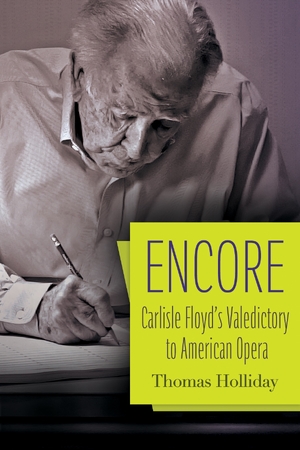
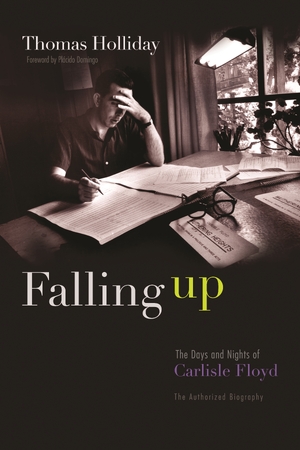
Encore: The Final Decade of Carlisle Floyd, published by Syracuse University Press in collaboration with the Carlisle Floyd Centennial, is now available. This companion to Falling Up: The Days and Nights of Carlisle Floyd follows the celebrated composer through his final, creatively fruitful decade—culminating in Prince of Players, his last opera, inspired by the life of banned Restoration-era actor Edward Kynaston. Drawing on reminiscences from those closest to Floyd, author Thomas Holliday crafts an intimate portrait of an artist who kept innovating and creating until the very end.
Review:
It is always a treat to get an insider perspective on the life of a great composer. . . . This book is written throughout in a very captivating and eminently readable fashion; we really get an idea of Carlisle Floyd, the man. ― Colleen Renihan, author of The Operatic Archive: American Opera as History
Recordings.
The Carlisle Floyd Centennial will ensure that all existing recordings of his works are made available on streaming platforms, allowing new generations to discover his music. Additionally, we will support the creation of new recordings to further celebrate and preserve his legacy.
Media.
The Carlisle Floyd Centennial will leverage social media, public relations, and integrated media strategies to promote centennial productions and amplify awareness of Carlisle Floyd’s lasting contributions to American opera. Through targeted outreach and engagement, the centennial will celebrate his legacy and introduce his work to new audiences.

DIVERSE, BUT UNMISTAKABLY AMERICAN
An American Song Album is a fine collection of songs by American composers, presented by soprano Melody Moore. The repertoire includes Samuel Barber’s introspective Hermit Songs, Jake Heggie’s engaged cycles These Strangers and How Well I Knew the Light, Carlisle Floyd’s exploration of motherhood in The Mystery, Copland’s impressionist and oriental Four Early Songs, as well as a varied selection from Gordon Getty’s vocal works. Set to Irish, Welsh, Chilean, German, Arabic and Afro-American poetry,
these pieces constitute a panorama of the US as a melting pot of cultures, while simultaneously being bound together by an unmistakably American sound. Melody Moore manages to lift out the poetry of these works with her warm, lyrical voice and impeccable vocal technique. She is accompanied on the piano by Bradley Moore, one of the most eminent conductors and song accompanists of today’s American musical scene.
With her first solo album, Melody Moore continues her PENTATONE discography that already features recordings of leading roles in Gordon Getty’s Plump Jack (2012) and The Little Match Girl (2015), as well as Desdemona in Verdi’s Otello (2017).

2021 GRAMMY® Nominee: Best Opera Recording
2021 GRAMMY® Nominee: Best Contemporary Classical Composition
Florentine Opera Company
Milwaukee Symphony Orchestra, William Boggs, Conductor
(2-CD set)
THE FLORENTINE OPERA BRINGS CARLISLE FLOYD’S DARING NEW OPERA, PRINCE OF PLAYERS, TO LIFE!
Carlisle Floyd (b. 1926 – Sept. 30, 2021) is one of the foremost composers and librettists of opera in the world today. Considered the “Father of American Opera,” Floyd’s operas are regularly performed in the US and Europe. He first achieved national prominence with the premiere of Susannah by the New York City Opera in 1956. His second opera, Wuthering Heights, premiered at Santa Fe Opera in 1958, and continues to have life decades later: a critically-acclaimed recording, released in June 2016 on Reference Recordings, was listed in Opera News’ 10 Best Opera recordings of 2016 (FR-721SACD Wuthering Heights).
During his long career, Floyd has composed 13 operas. His most recent, Prince of Players, which premiered in March 2016 at the Houston Grand Opera, is based on the true story of the Restoration-era actor Edward Kynaston (1640–1706). Remarks about Kynaston in the personal diary of Samuel Pepys inspired a play by Jeffrey Hatcher, Compleat Female Stage Beauty (1999), which was later made into a movie, Stage Beauty (2004). The plot centers on the crisis faced by Kynaston when, by royal decree, he is prohibited from plying the craft that made him famous—playing female roles. With this Milwaukee production, the Florentine Opera gives Prince of Players its world-premiere live recording.
J. Mark Baker describes the new opera in his essay Carlisle Floyd and Opera in America:
“In his newest work, Prince of Players (2016), composer-librettist Floyd again lays bare his passion for social justice and understanding. Though set in 17th-century England, the opera’s highly charged drama deals with issues that confront us in 21st-century America – among them, the intricacies of sexual orientation and gender identity, and the resulting societal consequences. Employing set pieces that evoke the Restoration era – a bawdy tavern song, courtly dances, a folksong used as a maladroit audition piece – and calling on his tried-and-true mixture of affecting lyricism and sometimes-jarring dissonance, Floyd convincingly depicts the world of the actor Edward Kynaston. It’s an inspiring – and true – story of an artist motivated by a soul-deep devotion to his chosen art form.”
Reference Recordings knew that Carlisle Floyd was intent on having a recording released of his newest creation during his lifetime. He writes in the album notes: “And now, having this outstanding performance recorded for the world to hear…my 93 year old heart is filled with joy and oh, so much gratitude!”
“The full-orchestral version of Carlisle Floyd’s Prince of Players does full justice to the sexual tensions of the historical period it adores… The dramatic impact is heightened by Phares’s unswerving classical line and intense underlying emotion set against Kate Royal’s stunning portrayal of the era’s first female superstar, moving from the music hall to starring with her lover. The Florentine Opera production features Alexander Dobson’s powerful, compassionate Thomas Betterton, tenors Chad Shelton, Frank Kelley and Vale Rideout as the King and his courtiers, and Rena Harms as Nell Gwyn, each of whom give full reign to their key roles. The participation of the Milwaukee Symphony further justifies the decision to record the full-orchestral version, to which Reference does its usual audiophile justice.” —Laurence Vittes, Gramophone
“rich dramatic fodder. Featuring a first-class cast led by Keith Phares as Kynaston and Kate Royal as his protégé-cum-lover Margaret Hughes, the storytelling comes over loud and clear thanks to a libretto, excellent diction all around, and a beautifully engineered recording. If you respond to opera at its most lyrical, this is for you.” —Clive Paget, Musical America

Florentine Opera Company
Milwaukee Symphony Orchestra
Joseph Mechavich, conductor
The Florentine Opera Company® brings American opera composer Carlisle Floyd’s operatic masterpiece, based on the classic English novel by Emily Brontë, to life. Floyd’s score takes you to the heart of Catherine and Heathcliffe’s devastating love story.
Carlisle Floyd’s canon of operas is amongst the most performed by any living American opera composer, however four essential operas have never been commercially released. Wuthering Heightswas first performed by Santa Fe Opera in 1958, but never recorded until now. With the composer acting as artistic advisor, this Florentine Opera premiere recording was made in January 2015 at the Sharon Lynne Wilson Center for the Arts, in Brookfield, Wisconsin. It features conductor Joseph Mechavich, soprano Georgia Jarman (Cathy), baritone Kelly Markgraf (Heathcliff), soprano Heather Buck (Isabella), tenor Vale Rideout (Edgar), tenor Chad Shelton (Hindley), mezzo-soprano Susanne Mentzer (Nelly), tenor Frank Kelley (Joseph), The Florentine Opera Chorus and the Milwaukee Symphony Orchestra. Reference Recordings is proud to release this exceptional recording.
General Director William Florescu states, “This is a unique and exciting Florentine Opera recording. Carlisle Floyd’s Wuthering Heights, an unjustly neglected American gem, made its Florentine debut in this world premiere recording. We had the honor of welcoming Carlisle Floyd to guide this exceptional creative team and shape the concert and recording. Noele Stollmack (director of design and production), conductor Joseph Mechavich (conductor for the Florentine productions of La Traviata 2013 and Carlisle Floyd’s Susannah 2012), Blanton Alspaugh and John Newton, along with all of the production engineers and recording specialists from SoundMirror assembled their talents to bring this premiere recording and concert to life–for live audiences and the world to experience.”
Carlisle Floyd, 90 years of age in June 2016, is still creating new operas (his newest, Prince of Players, was presented to great acclaim by Houston Grand Opera in March 2016), and is intent on having commercial recordings of all his operas released during his lifetime. Describing the music of Wuthering Heights as highly dramatic and quite melodic, Floyd has said he is thrilled to have it recorded. The Florentine has released plans to follow Wuthering Heights with recordings of Floyd’s Willie Stark and Bilby’s Doll.
Wuthering Heights was recorded and mastered by the team at Soundmirror, whose outstanding orchestral, solo, opera and chamber recordings have received more than 70 GRAMMY® nominations and awards.
Extra notes
Two-Disc Hybrid SACD contains 5.1 and Stereo SACD and CD stereo
DSD Download available through NativeDSD.com
On This Recording
Carlisle Floyd: Wuthering Heights World Premiere Recording
Disc One
Prologue
Scene One
Scene Two
Act Two: Scene One
Act Two: Interlude
ActTwo:SceneTwo
Disc Two
Act Two: Scene Two – Part II
Act Three: Scene One
Act Three: Scene Two
Act Three: Scene Three
Reviews:
“Maestro Joseph Mechavich leads his Milwaukee Symphony Orchestra and the choral forces of the Florentine Opera Company, one of America’s oldest such vocal organizations, in a precedent setting performance that will make listeners unfamiliar with this work sit up and take notice. Composer Floyd writes beautiful vocal lines and the cast led by stunning soprano Jarman takes full advantage of them. Vocal colleagues Markgraf, Rideout, Buck, and Shelton provide excellent support and credible recreations of their characters. Veteran mezzo-soprano Suzanne Mentzer turns in a great rendition of the old serving woman Nelly Dean. … Like Carlisle Floyd’s big hit Susannah, the star soprano gets a virtuosic monologue in Act II that sums up, with an economy of words and music, her deep feelings for Heathcliff: “Whatever our souls are made of, his and mine are the same.” This recorded première may finally set the operatic record straight regarding Wuthering Heights, particularly with a cast as good as this one. Audio values are tops and I doubt that we will get a better recording of this neglected masterpiece any time soon. Highly recommended!” —Lawrence Devoe, TheaterByte
“For much of the work Floyd writes in an expressive parlando style that allows the words to be clearly heard even when the voices are competing with large orchestral forces. The dark brooding orchestral score is, even allowing for the tragic nature of the story, mellifluous and often lushly romantic in the style of Puccini and Samuel Barber as, for example, in Edgar’s aria “Then marry me Cathy and make me whole again” (Act 2 Scene 2 ) ardently delivered by tenor Vale Rideout. Floyd’s confident handling of his orchestral palette and his ability to create atmosphere is clear from the start where the doleful horns that open the work immediately capture the bleakness of the North Yorkshire moor setting.
It would be hard to imagine a more committed and much better sung performance than that given here by the Florentine Opera Company, one that has the imprimatur of the composer. The casting of the principal roles is very strong and led by the the soprano Georgia Jarman as Cathy and the baritone Kelly Markgraf as Heathcliff. Jarman’s gleaming soprano has the power to ride over the orchestra when required, but she can also sing with great tenderness and her impassioned portrayal of the opera’s tragic heroine is wonderfully expressive throughout. Kelly Markgraf is a commanding and virile sounding Heathcliff whose rhapsodic account of “Was there ever another place in all the world like this!” (Act 1 Scene1) makes him the epitome of the romantic hero. The singers of the supporting roles generally don’t disappoint, with Susanne Mentzer (Nelly) and Heather Buck (Isabella) worthy of special mention. The Milwaukee Symphony Orchestra, firmly directed by Joseph Mechavich, does full justice to Floyd’s dramatic score with responsive and vibrant playing sumptuously recorded.” —Graham Williams, HR Audio

Comic one-act opera by Carlisle Floyd (Susannah), with the cast and conductor of the work’s premiere: Patricia Neway and Norman Treigle, with Julius Rudel leading the Orchestra and Chorus of the East Carolina School of Music. 1963 recording, never before issued. Digital audio mastering by Roderick Evenson.
[1999, Mono, 56 minutes]
Carlisle Floyd
THE SOJOURNER AND MOLLIE SINCLAIR
Comic Opera in One Act
Libretto by Carlisle Floyd
Cast:
Mollie Sinclair - Patricia Neway
Dougald MacDougald - Norman Treigle
Jenny MacDougald - Alison Hearne Moss
Lachlan Sinclair - William Newberry
Spokesman - Jerold Teachey
Orchestra and Chorus of the East Carolina College School of Music
Julius Rudel, conductor
(Recorded 1963)
*****
The Genesis of The Sojourner and Mollie Sinclair, by Carlisle Floyd
Sometime in 1962, a young woman, representing the North Carolina Tercentenary Commission, paid me a visit in Tallahassee, where I was living at the time. Her mission was to convince me to accept a commission to write a one-act opera as part of a celebration of North Carolina’s Tercentenary year in 1963. I can only assume in looking back that she must have been unusually persuasive, since I know that my initial response was an emphatic refusal, immersed, as I was, in completing my opera The Passion of Jonathan Wade for a premiere by the New York City Opera in October of that year. In addition, the proposed opera had to be written quickly, and there was nothing suggested as a source for the libretto other than the stipulation that it be related somehow to colonial North Carolina. With so many obstacles, I can’t imagine now that I ever agreed to the commission, so I suppose I have to credit the young woman’s tenacity or a momentary lapse in judgment on my part, or both. In any case, The Sojourner and Mollie Sinclair was the result, and the opera had its premiere on schedule in November of 1963.
To prod me, the young lady from North Carolina sent me a number of books dealing with colonial North Carolina, and it was from one of them that I derived the kernel for a story. I was intrigued by the fact that many of the settlers who had migrated from Scotland to the eastern part of the state had clung steadfastly to the social structure and customs of their native country while, at the same time, there was a vehement protest to the Stamp Act, an unmistakable indication that revolutionary feelings were already simmering. Dealing with these two opposing points of view, the reactionary and the revolutionary, then gave me the basis for a story in which these polarities could be personified by two powerful personalities, one a vainglorious old Scottish laird, fiercely maintaining the ways of the old world, and the other, a middle-aged Scottish woman, consumed by the fever of revolution and protest, who eagerly embraces the new. The collision of these two characters, I felt, would provide the necessary conflict out of which could come both comedy and drama, and each had his or her own adherents: the old laird’s dutiful and blindly loyal clansman on the one hand, and on the other, Mollie Sinclair’s rag-tag "brigade" of scruffy young men who, with her as their commander, were marching on Wilmington.
In one of those instances of the "chicken or the egg," I can’t remember now whether the idea of writing a work in which the two leading roles would be played by Norman Treigle and Patricia Neway occurred to me before or after I had the idea for the libretto. I have the feeling that it was probably before, since it seems to me that it may have been one of the factors that induced me to accept the commission. Whatever the sequence of events actually was, I do know that it had been a fervent wish of mine for some time (as well as others in the opera field) to see the two dynamic and riveting actor-singers on stage together since they both had a way of frequently eclipsing less charismatic fellow performers, not by any means other than their almost ferocious intensity on stage. It was fortunately an attractive idea to the two performers who had never previously worked together, especially since Julius Rudel, under whom they had both sung at City Opera, had, as a favor to me, agreed to conduct. Julius, then and now, one of the finest conductors of opera anywhere with a truly remarkable feeling for the stage, was heroic in circumstances that would have exhausted the patience of many conductors: in the first place, the orchestra was limited in my contract to only sixteen players, and, more significantly, the players were non-professionals tackling a new work in a musical idiom completely unfamiliar to them. Julius, to understate the case, more than earned his fee.
As for the Neway-Treigle combination, it was everything I had hoped for. Two very strong personalities on stage can sometimes cancel out each other, but not so in this instance: each seemed to fuel and ignite the other. Their ways of working were totally contrasted. Neway, highly intelligent and committed "method" nactor as she was, enjoyed detailed discussions with the very able director regarding her character and on-stage action, while Treigle, always the generous colleague and canny, instinctive, but private as an actor, sat calmly smoking his beloved Kool unfiltered cigarettes, waiting for the actual rehearsal to resume. What was so remarkable was that both artists, beginning in such opposite directions, ended up at the same point with performances that were unerringly genuine, compelling, and totally devoid of operatic artifice.
For me, it more than justified the stress I had felt in undertaking the commission simply to have witnessed Treigle and Neway performing together: two of the finest actor-singers of their generation, heralded for stunning dramatic portrayals, revealing true comic flair that was at the same time always combined with touching humanity. It is my hope that with the release of this recording some of the unusual excitement of that experience will emerge for present-day audiences.

Premiere recording of a one-act masterpiece by Carlisle Floyd. A taut and engrossing psychological melodrama with occasional lyrical monologues reminiscent of the composer's Susannah. Live 1966 world premiere performances in New Orleans.
[1995, Stereo, 72 minutes]
MARKHEIM
Opera in One Act
Music by Carlisle Floyd
Dramatization and text by the composer
after the story by Robert Louis Stevenson
Cast:
Markheim - Norman Treigle
Josiah Creach - Alan Crofoot
Tess - Audrey Schuh
A Stranger - William Diard
New Orleans Opera Orchestra and Chorus
Knud Andersson, conductor
(Composite recording based on the world premiere performances of March 31 and April 2, 1966)

Heidi Louise Williams performs piano sonatas by American composers with the oldest work written in 1919 and the most recent in 1991. Charles Tomlinson Griffes, George Walker, Carlisle Floyd, and Samuel Barber all used their art to explore imponderable realities that could be more fully accessed within the realm of music. These artists absorbed a variety of musical languages into their own, foreshadowing, in many cases, the postmodernist aesthetic of stylistic coexistence. From Walker's inclusion of folk tunes to Barber's gripping sincerity, from Floyd's devotion to human narratives to Griffes' persuasive fusion of styles, these works rely in some way or another on the power of human empathy, nobly representing the United States as an essentially diverse nation. Praised by critics, pianist Heidi Louise Williams has appeared in solo and collaborative performances across North America and internationally, having won numerous awards. A graduate of Peabody, she is on the faculty at Florida State University. This is her second solo album for Albany Records.